A letter to the Canadian Prime Minister, with two suggestions for next steps in dealing with #COVID19

Prime Minister,

I certainly hope you and yours are well.

I was in New York City up until last weekend. Earlier in the previous week the university where I work announced that it was moving all courses online, and closing the campus. There was really no further need for me to stay in the City, but my initial thought was to wait it out, and decide later on when to return to Canada.

I started to have second thoughts when a student emailed me for advice just after President Trump announced that travel from Europe to the United States would be banned. He’s from Mexico, and said that he trusted the Mexican health care system more than the American, and wanted my advice on whether he should return home.

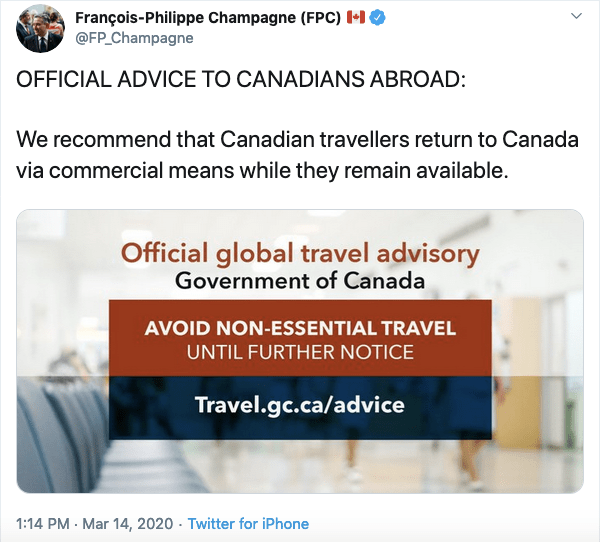
If that wasn’t enough to give me pause, when I saw the twitter feed of the Minister of Foreign Affairs  on Saturday evening recommending “that Canadian travellers return to Canada via commercial means while they remain availableI immediately bought myself a ticket for a next day flight to Canada. I arrived last Sunday evening, and have been in self-isolation since. I’m glad to be home given the events of the last week.
It is certainly time for government to step up, and history will judge the fall out of this pandemic in terms of how well societies govern themselves: professionally and efficiently, scientifically and socially, and with a sense of reciprocity and trust that strengthens community. I hope you and your cabinet take to heart a message that one of my colleagues has written in an article called “The Real Pandemic Danger Is Social Collapse.”

… the main (perhaps even the sole) objective of economic policy today should be to prevent social breakdown. Advanced societies must not allow economics, particularly the fortunes of financial markets, to blind them to the fact that the most important role economic policy can play now is to keep social bonds strong under this extraordinary pressure.

Good governance, not just a good health care system, is one of the reasons I’m glad to be home. I have been watching your daily press briefings with a good deal of admiration. And I am also impressed with both the design and speed with which the government has been able to roll out the package of reforms earlier this week, an effort that has no doubt been supported by legions of professional public servants working around the clock.

You promised that these reforms are just the first step in a fast moving and dynamic situation. I can’t pretend to understand the complete situation, hardly have full information, and can’t offer wide-ranging suggestions on what the next steps might be. But here are two suggestions that come from my limited areas of expertise. Continue reading “A letter to the Canadian Prime Minister, with two suggestions for next steps in dealing with #COVID19”
My Mandate Letter for the Minister of Families, Children and Social Development

The first step a newly elected Prime Minister takes on the road to governing is choosing the members of cabinet and giving them their marching orders. Prime Minister Trudeau set to this task with zeal when he was first elected in the autumn of 2015, and surprised many by making the mandate letters public. The CD Howe Institute asked a number of experts to draft their versions, and this post offers a slightly longer version of the mandate letter I wrote for the Minister of Families, Children and Social Development published by the Institute.

Click on image to link to the 2015 Mandate Letter

All Canadians have a right to live the life they value with dignity.

As Minister of Families, Children and Social Development, your actions should be governed by this principle, and directed to three concerns:

  1. promoting economic well-being and ensuring that those facing challenging circumstances are able to fully participate in our society with dignity;
  2. fostering equal opportunities and inclusion for all, regardless of family background, gender, ethnicity, or sexual orientation;
  3. enhancing economic and social resilience, whether Canadians live in families or on their own.

With these in mind, I will expect you to work with your colleagues through established legislative, regulatory, and Cabinet processes to deliver on your top priorities.

Continue reading “My Mandate Letter for the Minister of Families, Children and Social Development”

How do the party platforms address the changing nature of work, pay, and poverty?

The world of work is changing and creating anxiety about jobs and incomes. There is some overlap on how the major parties contesting the Canadian federal election propose to deal with these challenges, but the Conservatives are definitely the outlier. The Greens score high on vision but low on feasibility,  both the New Democrats and Liberals put a list of reasonable proposals on the table, with the Liberals offering a bigger vision that is also feasible. The Conservatives don’t seem to propose anything to address the world of work, imagining citizens as consumers, and implicitly offering a smaller role for government in the workplace.


The “changing nature of work” has to be—right up there with climate change—one of the hottest issues facing Canadians, a big cause of uncertainty and insecurity that underlies the middle class malaise that all of the parties contesting the Canadian federal election are hoping to address.

And quite rightly so. The future of work and globalization should raise a lot of anxiety. Richard Baldwin’s latest book, The Globotics Upheaval: Globalization, Robotics and the Future of Work, argues that as powerful innovations in digital technology meet globalization many higher paid workers in service jobs will be confronted with the disruptions that workers in manufacturing jobs had to deal with during the first wave of globalization during the 1990s.

If, as he argues, its “coming faster than most people believe,” then what should the politicians vying for our votes be doing about it? The first step for public policy is to foster higher and more secure incomes, and to offer better insurance.

How well do the platforms and promises stand up? I offer a review of the four major parties in the same spirit as the excellent review by Trevor Tombe and his co-author on climate change policies. Read “How The Four Federal Parties Climate Plans Stack Up” published in Chatelaine, and you will notice that my labour market and social policy scorecard is essentially the same.

Continue reading “How do the party platforms address the changing nature of work, pay, and poverty?”

The changing nature of work calls for enhancing the human and financial capital of children in less wealthy families

The Canadian federal government should enhance the human and financial capital of children in less wealthy families, enhance market incomes of lower paid workers, and enhance the security of working incomes by adapting three existing programs to new realities: widening their scope, making them more flexible, and making them easier to obtain.

The changing world of work is also a changing world of pay, a world that will likely lean toward greater wage rate inequalities, lower or stagnating incomes for the bottom 40 percent, and greater income insecurity for the broad majority.

I suggest three changes to current public policies that take incremental, but important, steps toward fostering capital accumulation among children from less wealthy families, increasing market incomes earned from that capital for the working poor, and finally enhancing income security for the broad majority.

These policies lean toward encouraging inclusive growth, in which the benefits of the new world of work and pay are broadly shared.

In this post I discuss the first policy proposal, which is:

Enhance human and financial capital by making community colleges tuition-free, and making the Canada Learning Bond more flexible

Continue reading “The changing nature of work calls for enhancing the human and financial capital of children in less wealthy families”

Thinking about minimum wages, and thinking about them like an economist

There is a movement afoot, and there is an election in the offing. Always a great dance to watch, no matter what the issue.

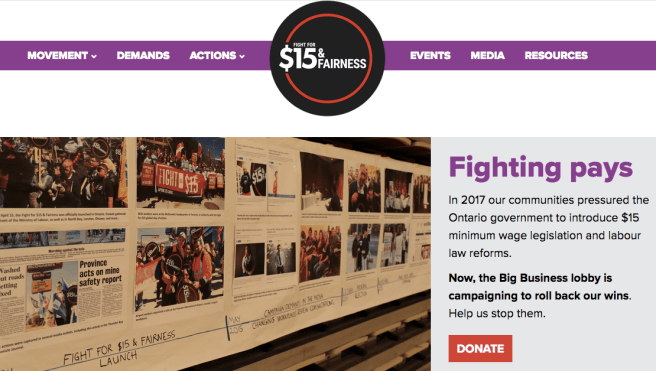
The latest show is taking place in Ontario, where “$15 & Fairness” is the rallying call for raising the minimum wage, and has found a willing partner in the province’s Premier who will go to the polls in the spring, but in the meantime has legislated significant increases in the minimum price for an hour of work. The same dance plays out in the United States, and in many cities and states a minimum wage of $15 per hour is becoming a reality.

The big question in Ontario is exactly that raised by The New York Times during the 2015 primaries when Bernie Sanders was battling Hillary Clinton for the Democratic nomination: “As the campaign for a $15 minimum wage has gained strength this year, even supporters of large minimum-wage increases have wondered how high the wage floor can rise before it reduces employment and hurts the economy.”

Something to think about, but how would you think about it if you were an economist? Here are four rules of the road that might come in handy regardless of which dance you might be watching next time.

Continue reading “Thinking about minimum wages, and thinking about them like an economist”

Can you change your mind about inequality? Read my just published paper

The Pope has strong views about inequality because he has a theory, and doesn’t need data.

pope-francis-tweet-inequality-is-the-root-of-social-evil

One of Canada’s most prominent pundits has strong views about inequality because he has data, and doesn’t need theory.

andrew-coyne-tweet-november-24-2016-inequality-is-an-utter-crock

I’ll probably never convince either of them to change their views, but maybe I can convince you with both theory and data.

Give me the chance by reading my just published paper, Inequality is the root of social evil,’ or Maybe Not? Two Stories about Inequality and Public Policy.”

I tell two stories about inequality. The first is from the perspective of those who feel it is not a problem worth the worry, and the second from the perspective of those who see it as “the defining challenge of our time.” I tell these stories to clarify their underlying logic, but also to clarify both the challenges facing Canadians and our understanding of what public policy should do about them.

But I have another motive. I would like you to appreciate the value of economic theory and statistical methods to a public policy discussion of this sort. It seems to me that without an appreciation of some basic elements of theory and measurement, it is too easy for the policy conversation to go astray.

Download a free copy from the publisher’s website—Canadian Public Policy, December 2016—and tell me what you think.